Step-by-step guide to reject spam or unwanted inbound calls on Bolna Voice AI agents by maintaining your own blocklist of phone numbers and prefixes using caller identification.
Bolna lets you reject unwanted inbound calls (spam, promotional callers, specific number ranges) before the agent answers and before any AI or telephony usage is incurred. Instead of configuring individual numbers on Bolna, you keep the blocklist on your side and let Bolna consult it on every incoming call.This works by combining two existing inbound features:
Caller identification — Bolna calls your API (or looks up a CSV / Google Sheet) with the caller’s number before the call is answered.
Allow Calls Only from Database — a toggle in the Inbound tab that rejects any caller for whom no record is found.
Your API decides who gets through: return caller data for allowed numbers and an empty result for anything you want to block. Because the check runs in your own code, you can block single numbers, whole prefixes, or number ranges, and update the list at any time without touching Bolna.
This guide uses the Internal API data source because it is the only option that lets you express prefix and range rules. CSV and Google Sheet sources only support exact-match allow lists.
Incoming call from +917947012345 │ ▼Bolna → GET https://api.your-domain.com/callers?contact_number=%2B917947012345&agent_id=...&execution_id=... │ ├── Number matches your blocklist (e.g. prefix +9179470*) │ → your API returns an empty result │ → "Allow Calls Only from Database" is ON, so Bolna rejects the call │ → the agent never answers, no usage is billed │ └── Number is allowed → your API returns caller data (JSON) → Bolna answers and injects the data into the prompt
Decide which callers to reject. You can mix exact numbers and prefixes. Store the list wherever is convenient for you — a config file, a database table, or an environment variable.In this guide we block the entire +9179470 range (written as +9179470*) plus one specific number:
Always store and compare numbers in E.164 format (+ followed by country code and number, no spaces or dashes). This is the format Bolna sends in contact_number.
2
Build a GET endpoint that checks the caller
Create a GET endpoint that accepts the query parameters Bolna sends:
Parameter
Description
contact_number
Incoming caller’s phone number (E.164)
agent_id
Agent handling the call
execution_id
Unique identifier for this call
The endpoint must:
Return an empty result ({}) when the number is blocked.
Return a JSON object with caller details when the number is allowed.
Respond within 3 seconds.
from fastapi import FastAPI, Queryapp = FastAPI()BLOCKED_PREFIXES = ["+9179470"] # blocks +9179470*BLOCKED_NUMBERS = {"+911234567890"} # exact matchesdef is_blocked(number: str) -> bool: if number in BLOCKED_NUMBERS: return True return any(number.startswith(prefix) for prefix in BLOCKED_PREFIXES)@app.get("/callers")def identify_caller( contact_number: str = Query(...), agent_id: str = Query(None), execution_id: str = Query(None),): if is_blocked(contact_number): # Empty result → Bolna finds no record and rejects the call return {} # Allowed caller → return whatever data you want in the prompt. # Replace this with a lookup in your CRM/database. return { "first_name": "Bruce", "last_name": "Wayne", "account_status": "premium", }
const express = require("express");const app = express();const BLOCKED_PREFIXES = ["+9179470"]; // blocks +9179470*const BLOCKED_NUMBERS = new Set(["+911234567890"]); // exact matchesfunction isBlocked(number) { if (BLOCKED_NUMBERS.has(number)) return true; return BLOCKED_PREFIXES.some((prefix) => number.startsWith(prefix));}app.get("/callers", (req, res) => { const { contact_number } = req.query; if (isBlocked(contact_number)) { // Empty result → Bolna finds no record and rejects the call return res.json({}); } // Allowed caller → return whatever data you want in the prompt. // Replace this with a lookup in your CRM/database. res.json({ first_name: "Bruce", last_name: "Wayne", account_status: "premium", });});app.listen(3000);
If you do not have caller data for allowed numbers, return any non-empty JSON object (for example {"allowed": true}). Only an empty result triggers the rejection.
Your API must respond within 3 seconds. If it times out, Bolna treats the lookup as returning no data — with the restriction toggle enabled this means the call is rejected, so make sure your endpoint is fast and highly available.
3
Connect the endpoint to your agent
In the Bolna dashboard, open your inbound agent and go to the Inbound tab.
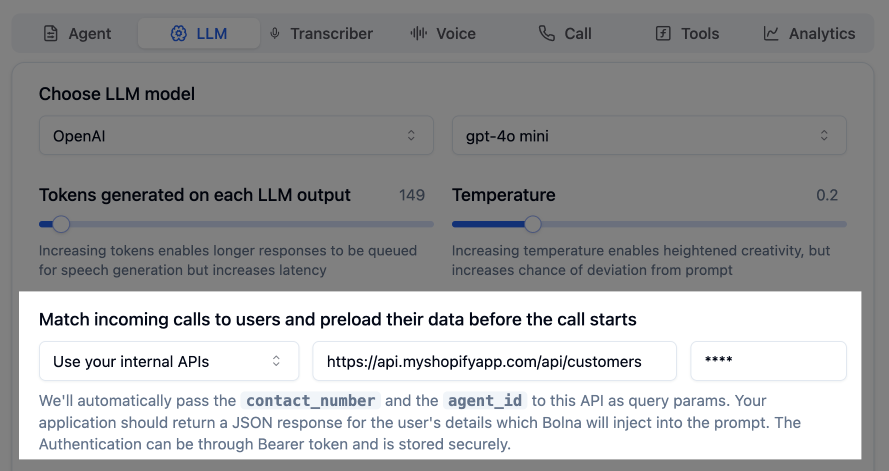
Under Database Matching, choose “Use your internal APIs” from the dropdown.
Enter your endpoint URL, for example https://api.your-domain.com/callers.
Optionally add a Bearer token so only Bolna can call your endpoint.
Connecting an internal API for caller identification
4
Turn on 'Allow Calls Only from Database'
Still in the Inbound tab, under Call Restrictions, toggle on “Allow Calls Only from Database”.This is what converts an empty result into a rejected call. Without it, blocked callers would still reach the agent — just without any injected data.Save the agent.
5
Test the blocklist
Verify your endpoint behaves correctly before routing live traffic:
Then place a test call to your Bolna number from a blocked and an allowed phone. The blocked call should be rejected without the agent answering; the allowed call should connect as usual.
All matching happens in your code, so any rule you can express is supported. Common patterns:
Rule
Example
Implementation
Single number
+911234567890
Exact string match
Prefix / number range
+9179470*
number.startswith("+9179470")
Entire country
+1*
number.startsWith("+1")
Regex
^\+9179470\d{5}$
Regular expression match
Dynamic list
numbers flagged in your CRM
Database lookup
Because the blocklist lives on your side, you can update it instantly — add a spammer’s number to your database and the very next call from them is rejected. No changes are needed on Bolna.
You can combine both behaviours in the same endpoint:
Allow list first: if the number is a known customer, return their data.
Blocklist next: if the number matches a blocked prefix, return {}.
Everyone else: either return {} (strict, only known callers get through) or a minimal non-empty object like {"known": false} (open, unknown callers are still answered).
def identify_caller(contact_number: str):
    customer = crm.lookup(contact_number)
    if customer:
        return customer                       # allowed, with data
    if is_blocked(contact_number):
        return {}                             # rejected
    return {"known": False}                   # unknown but answered