
Start with the trunk page
Open SIP Trunks and the trunk in question.- Health on the Overview tab: Waiting for carrier means no call has crossed the trunk yet. Degraded means the last three or more outbound calls failed at the carrier; one answered call clears it. Disabled means the trunk is switched off, so it takes and places no calls.
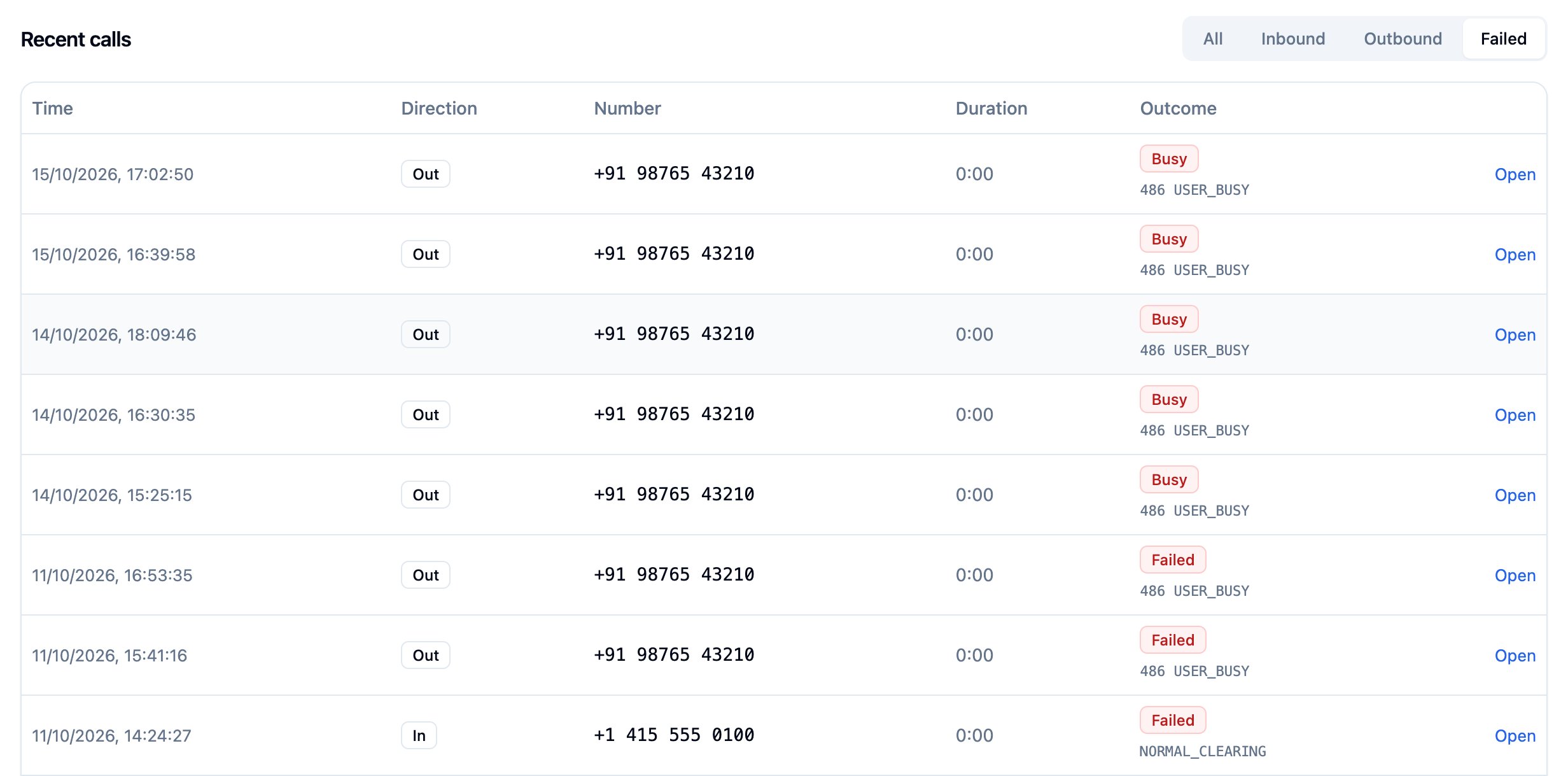
- Recent calls on the Activity tab lists the trunk’s calls. Filter by Failed to see calls that did not connect, with the SIP code and cause each one ended with. Open takes you to the call in Call History.
- Test inbound and Test outbound on the same tab place an echo call without an agent, which separates carrier problems from agent problems. See Verify with a test call.
Failed calls on the Activity tab
Inbound calls are refused
When Bolna refuses an inbound call, it answers your carrier’s INVITE with one of these responses. Your carrier’s call logs show the code.Changes to carrier IPs apply within 5 seconds. Bolna checks only the source address of the INVITE; it never trusts the
From header to identify the carrier.Outbound calls fail
A failed outbound call carries an error on its execution. These come from Bolna:
When your carrier refuses the call, the Activity tab shows its SIP code:
A busy line or a callee who does not answer within 60 seconds ends the call as
busy or no-answer; that is not a trunk fault and does not affect the trunk’s health.
If outbound calls stay queued, every channel on the trunk is in use. Calls wait for a free channel rather than failing; raise Channels if they wait too long.
The call connects but there is no audio
Audio on a trunk call is RTP over UDP between your carrier and15.252.21.46, on ports 30000-40000.
- Nobody hears anything, or only one side does. The carrier, or a firewall between it and Bolna, is blocking RTP. Allow UDP
30000-40000to and from15.252.21.46, and check that the carrier sends media to the address and port in Bolna’s SDP answer. - The call drops about a minute after audio stops arriving. Bolna hangs up a call when it receives no RTP from the carrier for 60 seconds. Fix the RTP path as above, and turn off silence suppression on the carrier if it stops sending RTP while nobody speaks.
- Keypad presses are ignored. Bolna reads DTMF only as RFC 2833 telephone events. SIP INFO digits are ignored. Set the carrier to RFC 2833, also called RFC 4733 or out-of-band DTMF.
”Call could not be connected.”
Bolna records this error on a call that never reached the agent and has no more specific cause. On an inbound call, it usually means the carrier cancelled the call before it was answered, or Bolna could not connect it to the agent. On an outbound call, see Outbound calls fail.Transfers fail
A transfer that is dialled and then fails, because the target is busy or does not answer, ends the call. A transfer Bolna cannot dial at all, for example a SIP URI that is not on one of the trunk’s gateways, rings nothing. See Call transfer for both cases.Still stuck?
Send support the trunk ID (Copy trunk ID in the trunk’s menu), the execution ID of a failed call, and your carrier’s log entry for it. Every outbound and transfer INVITE carries the execution ID in itsX-CLIENT-CALL-ID header, which helps match the two.